Lev Manovich states that "today we are in the middle of a new media revolution -- the shift of all of our culture to computer-mediated forms of production, distribution and communication" (Manovich, 2002, P43). This is where Manovich begins to show us how the factors of the media revolution has changed and adapted through the years; right back to the beginning; from "Babbage's Analytical Engine" and "Daguerre's Daguerreotype" till the "Modern Digital Computer" of calculations of the digital age. Manovich "reduces all principles of new media of new media to five: numerical representation, modularity, automation, variability and cultural transcoding" (Manovich, 2002, P44). Computers were invented at first to carry out the process of a calculation, where now new media is the process of the digital code allowing computers to become a "media processor" (Manovich, 2002, P48).
Manovich adds that "human intentionally can be removed from the creative process" (Manovich, 2002, P53). This shows that people in today's society are able to take a back seat and not physically interactive and produce advanced media forms and all with a click of a button. The arise of the 'New Media' it allows software programmes to create, edit and filter the consumers 'collective intelligence', through the use of 'Instagram' therefore for we now rely on advanced technologies to produce rather that the manual 'Old Media' form. This then enhances society's "low level automation of media creation" (Manovich, 2002, P53). Therefore bringing up the question of whether or not that the 'New Media' forms are dumbing down the society? As Manovich adds that everyone "concerned as much with accessing and re-using existing media as with creating new one" (Manovich, 2002,P55). This clashes with Jenkins theory of 'Collective Intelligence' in where "convergence occurs within the brains of individual consumers (..) construct[ing] our own personal mythology from bits and fragments of information extracted from the media flow" (Jenkins, 2008, P3) showing with help of automated technology, the production outcomes can only become stronger and that if it wasn't for this combination we wouldn't have the shaped society that exists today.
"New Media is interactive" (Manovich, 2002, P66) and Manovich shows how computerisation interlinks with communication and allows the process of virtual and reality to come together to create 'software agents', therefore this monitors our media; which is of our "abundance of information" (Manovich, 2002, P55) and ranked to occurrence of relevance, allowing to build a portfolio of selections and choices. This clearly shows that we are being monitored over, controlled and have limitations to our actions by the 'New Media' forms bringing up Manovich statement of "do we want, or need, such freedom?" (Manovich, 2002, P62).
Bibliography
Books
Manovich,L. (2002) The Language of New Media, (Cambridge, Mass: London MIT Press)
Jenkins,H. (2008) Convergence Cuture: Where Old and New Media Collide, ( New York University Press: London)
Showing posts with label Old Media. Show all posts
Showing posts with label Old Media. Show all posts
Wednesday, 16 October 2013

Wednesday, 9 October 2013
Convergence Culture
"convergence culture, where old and new media
collide... the flow of content across multiple media platforms". (Jenkins,
2008 pg 2)
Henry Jenkins give us a in depth insight into how convergence culture surrounds
us every day. Each media platform we use
is a combination of old and new media. Companies such as Apple have taken old
media such as a personal music player and combining it with a new media mobile
phone which allows us to access many different platforms within one device. Therefore, the boundary between new and old
media is beginning to become a small fading line.
However, Jenkins believes "convergence represents a cultural shift as consumers
are encouraged to seek out new information and make connections among dispersed
media content" (Jenkins, 2008 pg 3) Jenkins persuades the reader to
believe that we, the consumers of media platforms have a influence on
convergence culture. In my opinion, I agree with Jenkins. Today the consumers
have such a high demand for more actions to be performed on one device.
Producers therefore try to satisfy our demand. We have realised the power we
have to create basically, what we want. Through this power, we have pushed the
shifts of old media to new. We can now access any content across the internet
through our new media. This relationship between the consumer and producer has
been named by Jenkins as 'participatory culture'.
Jenkins speaks of 'delivery technologies'. In my opinion I feel participatory
culture has an immediate effect upon delivery technologies. Jenkins explains, "old media never die...
what dies are simply the tools we use to access media content" (Jenkins,
2008 pg 13). Take music for a example, it is the medium. The old media cassettes
are the delivery technologies. As the years have passed, we have seen new media
delivery technologies from the cassette to CD's which are slowly going to be
replaced. In reality though, all media content will not be able to flow through
one single black box. Devices have become so in depth that it has lost the
ability to serve its original function.
We are surround by
convergence culture. It changes relationships, it alters our thoughts and our
ability to process media.
Bibliography
Books
Henry, J (2008) Convergence Culture: Where old and new media collide. New York University Press: London
Bibliography
Books
Henry, J (2008) Convergence Culture: Where old and new media collide. New York University Press: London
Convergence culture
Convergence culture is when new media replaces old media because technologies keep evolving and so the media industry has to keep up on all the new technologies. These platforms of media will be constantly evolving a good example of this would be Microsoft and Sony. Sony created the Play-station in 1994 and brought gaming to a new level and as the newer consoles came out the PlayStation became obsolete so they came up with the PlayStation two then their competitor created a gaming console called the Xbox. These consoles are now in a console war that separates their fans and they continue to try and bring more to their consumers for example the new Xbox called the Xbox one is trying to be the new main “black box” with everything in one as an entertainment system for example voice commands, TV, Internet, YouTube etc while the PS4 made by Sony is trying to be the main gaming console out there and just want to make a good console. Pictures of these can be seen below [Fig .1]
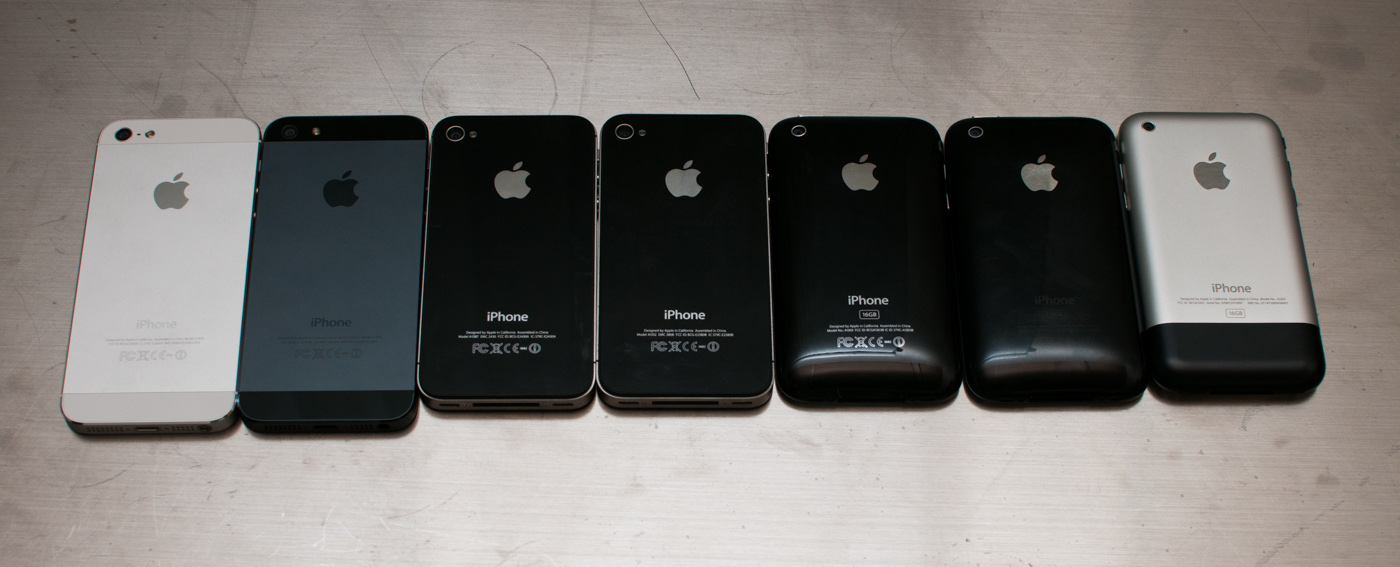
We can look at convergence culture in another light, one where old and new media forms can co-exist. This would be a better version of the older product. If we look at the way mobile phones are now compared to what they used to be for example a phone started as a simple communication device but now it has been upgraded and adapted over the years. The way phones are now you can have the internet, touch screen, MP3 player, movie player, you can download apps that do things like make music, learn music, play games and you can even get an app that allows you to play older games from other consoles like the super Nintendo or the gameboy. The progression of the iPhone can be seen below [fig.2]

 |
| Figure 1 |

References:
Henry Jenkins (2006) Where Old and New Media Collide, Introduction "Worship at the Altar of Convergence" p.1-25
Henry Jenkins (2006) Where Old and New Media Collide, Introduction "Worship at the Altar of Convergence" p.1-25
Images:

Convergence Culture
Jenkins stated "we are entering an era where media will be everywhere and we will use all kinds of media in relation to one another" (Jenkins,2001). This is based on Jenkins' theory of Convergence Culture where old and new Media collide, facilitated by new media devices such as laptops, tablets and smartphones. I agree with Jenkins- "old media[s] never die" (Jenkins,2008,P130). For example I can read a hard back book, but it could just as easily be accessed as an eBook. Media does not disappear, but shifts and changes across various platforms over time.
Media convergence is where "important stories gets told, every brand gets sold, and every consumer gets courted across multiple media platforms" (Jenkins,2008,P3). An example would be how the 'Bert Is Evil' image crossed several platforms from America to the Middle East. Moreover convergence allows the consumers to connect to disparate media which allows more information. Consumers don't have to experience "the old idea" which was where, all devices would converge into one central device" (Jenkins,2008,P15). They can for example now instead experience the second screen, thus creating a unique feeling, where one device can be as good as the other. This shows that "television did not kill radio"(Jenkins,2008,P14) instead the old mediums developed. However negatively- now consumers can access any media content from across the globe allowing easy access to and spread of child pornography. There are no restrictions on media content in general, and this may have serious repercussions for the old moral order.
Participatory culture see's the rise of the consumers forming fan club communities, interacting with corporate businesses and media industry producing collective intelligence " none of us can know everything; each of us knows something; and we can put the pieces together if we pool our resources and combine our skills"
(Jenkins,2008,P4). Convergence is shaped by the individual consumers who interact with others through the new media devices, and each individual is thus able to will gain a "personal mythology (...) [which is] extracted from the media flow" (Jenkins,2008,P3). Consumers are now realising that their input will allow them to slowly control the media flow. Quality is an issue here an individual consumer producing media content can produce an amazing artefact, or a disastrous one; this individualism may balance the growth of media power and affect how we consume media content and what may be consumed. It is hard to argue against the view that "the flow of content across multiple media platforms, the cooperation between multiple media industries, and the migratory behaviour of media audiences who will go almost anywhere in search of the kinds of entertainment experiences they want" (Jenkins,2008,P2).
Bibliography
Books
Henry,J (2008) Convergence Culture: Where old and new media collide. New York University Press: London
Websites
Henry Jenkins (2001) Convergence? I Diverge [Online]. Available at:
http:/www.technologyreview.com/article/40102/convergence-i-diverge/ (Accessed: 08/10/2013)
Media convergence is where "important stories gets told, every brand gets sold, and every consumer gets courted across multiple media platforms" (Jenkins,2008,P3). An example would be how the 'Bert Is Evil' image crossed several platforms from America to the Middle East. Moreover convergence allows the consumers to connect to disparate media which allows more information. Consumers don't have to experience "the old idea" which was where, all devices would converge into one central device" (Jenkins,2008,P15). They can for example now instead experience the second screen, thus creating a unique feeling, where one device can be as good as the other. This shows that "television did not kill radio"(Jenkins,2008,P14) instead the old mediums developed. However negatively- now consumers can access any media content from across the globe allowing easy access to and spread of child pornography. There are no restrictions on media content in general, and this may have serious repercussions for the old moral order.
Participatory culture see's the rise of the consumers forming fan club communities, interacting with corporate businesses and media industry producing collective intelligence " none of us can know everything; each of us knows something; and we can put the pieces together if we pool our resources and combine our skills"
(Jenkins,2008,P4). Convergence is shaped by the individual consumers who interact with others through the new media devices, and each individual is thus able to will gain a "personal mythology (...) [which is] extracted from the media flow" (Jenkins,2008,P3). Consumers are now realising that their input will allow them to slowly control the media flow. Quality is an issue here an individual consumer producing media content can produce an amazing artefact, or a disastrous one; this individualism may balance the growth of media power and affect how we consume media content and what may be consumed. It is hard to argue against the view that "the flow of content across multiple media platforms, the cooperation between multiple media industries, and the migratory behaviour of media audiences who will go almost anywhere in search of the kinds of entertainment experiences they want" (Jenkins,2008,P2).
Bibliography
Books
Henry,J (2008) Convergence Culture: Where old and new media collide. New York University Press: London
Websites
Henry Jenkins (2001) Convergence? I Diverge [Online]. Available at:
http:/www.technologyreview.com/article/40102/convergence-i-diverge/ (Accessed: 08/10/2013)
Subscribe to:
Posts (Atom)